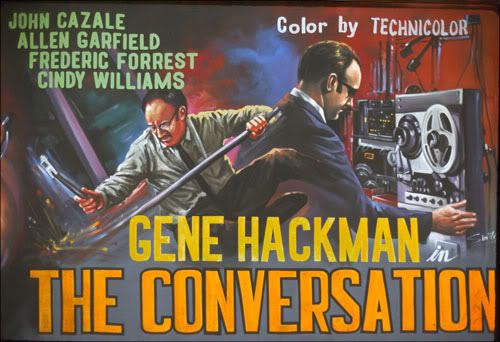
 The Conversation | rel. 1974 | dir. Francis Ford Coppola
This is July's Movie of the Month at the LAMB.
Slow, tedious, and boring are words that come to mind when I try to describe Francis Ford Coppola's 1974 film, The Conversation. It is certainly not a terrible film, per se, but it is far from being entertaining or engaging.
Made between The Godfather and The Godfather: Part II, Coppola's The Conversation is a vastly different film. While the Godfather films have several plotlines and a huge ensemble cast, The Conversation has only one major plotline and several key characters. The Conversation is a character study that hovers over the characters, but keeps a certain distance from them as well. Since no character ever gets too close, the film never gets too far.
Coppola is attempting a full-blown emulation of the suspense apparent in most Alfred Hitchcock movies. Because of this, it constantly feels like the audience is watching an experiment rather than an actual film. Like Hitchcock, Coppola does not care for cheap horror. He wants to hear heartbeats becoming faster and faster. The blunt simplicity of The Conversation is similar to Hitchcock's Rear Window, but Rear Window is an engaging, funny, charming, and beautifully thrilling mystery while The Conversation is most definitely not. Coppola is searching for a special category of suspense, albeit quite unsuccessfully.
It is obvious to any eye that Coppola is a competent director, so some moments of suspense do tick, but his own script never does. Just like Hitchcock once said, "To make a great film you need three things: the script, the script and the script."
The script is unapologetically minimalistic. Perhaps Coppola isn't only going for the Hitchcock vibe. He was going to strive for something revolutionary. Unfortunately, his film lingers like a lone vagabond, hoping it will get somewhere, but never really gets to its final destination. It makes me think that Sofia Coppola watched her father's film several times before making Lost in Translation. Although both films are of entirely different genres, they have the same minimalistic feel that isn't engaging and annoyingly bare.
The film stars Gene Hackman as Harry Caul, a paranoid and somewhat sociopathic surveillance expert who works in San Francisco. Years of hard work and dedication has earned him accolades and even fame from those of his line of expertise, but being the guy who eavesdrop on things he shouldn't hear is tough. Those thousands of dollars for a day's work does not compensate for the guilt and fear that constantly lurks in Harry's mind.
While doing a private surveillance job, Harry records a conversation between a couple, Ann (Cindy Williams) and Mark (Frederic Forrest). In their conversation, Ann and Mark express fear of Ann's husband, who is displeased of Ann's infidelity. Harry listens to the conversation over and over again, fearing for the couple's safety and hoping that this job will not lead to murder, like one of his previous jobs.
As Hackman expresses his character's guilt and sorrow through subtle facial expressions, Harry is not a likable character. He is not on friendly terms with his co-worker, Stan (John Cazale) or open about his personal life with his girlfriend Amy (Teri Garr). But undoubtedly, Hackman is the right actor for this kind of character. Hackman possesses a discreet macho intensity that is apparent in every film that I have seen him in, maybe with the exception of his hilarious cameo in Young Frankenstein.
That said, Hackman is the ultimate man's man. He does not have the conventional Hollywood handsomeness or the thrilling magneticism of his contemporaries, but he knows how to give the appropriate kind of performance for any character he takes on. With a pair of glasses and a mustache, Hackman makes Harry another ordinary, saxophone-loving man that one may encounter on the street. Harry is easily seduced by beautiful women. He loses his temper. Most importantly, he is simply not perfect. Hackman owns this persona, and in The Conversation, he finds just about the right colors to fill in the lines of Harry's character.
Most notably, Hackman and Cazale seem to hold the screen together, especially in a scene where Stan confronts Harry of his extreme secrecy. A little later in the film, Harry apologizes and Stan tries to accept the apology as best he can. The characters are finally put under the microscope, but by not exploring these two characters' relationship as much as Coppola could have, the audience never makes a meaningful discovery about the characters.
The rest of the supporting cast is effective, if not extremely memorable. Robert Duvall plays the husband of the unfaithful wife and Harrison Ford plays the assistant. Duvall's and Ford's scenes have a mysteriously enigmatic vibe that draws a certain kind of suspicious attention. There is an interesting scene that involves another guy in the wiretapping biz, Moran (Allen Garfield) and his flirtacious assistant-showgirl (Elizabeth MacRae), who both create a tiny splash in the film. Garr gives an acceptable performance, but it is Williams and Forrest who repeatedly and understandably haunts the protagonist. Williams's and Forrest's memorable appearances may be due to the fantastic editing by Richard Chew and Walter Murch. It is not a cheap flashback scene, but one that torments and dwells.
Admittedly, there are flashes of brilliance in The Conversation but they act like a dazzling puzzle that simply cannot fit in a midst of dullness. There are one too many flashbacks that don't make a statement and far too many scenes that move one miliscule at a time and arrives at nowhere. An interesting dream sequence occurs, but it feels like an empty attempt at building a character's already-known guilt. There is an intensely violent scene near the end of the film, but it never fully gives a one-two punch for the audience to care. For some reason, it is much too easy to know that the entire film was leading to that exact moment. But the grand act of heroism that we could only hope to surface flutters away before our eyes.
Accompanied by David Shire's uncluttered piano score, the film's tone feels like a marriage between the music of George Gershwin and Bernard Herrmann. Like its soundtrack, the film is too, uncluttered. It is a film about the voices of a conversation, but The Conversation never makes much noise. One can only wish that Coppola's ambitious, minimalistic story could be as classic as Gershwin and as chilling as Herrmann.
Rating: 5.5/10

